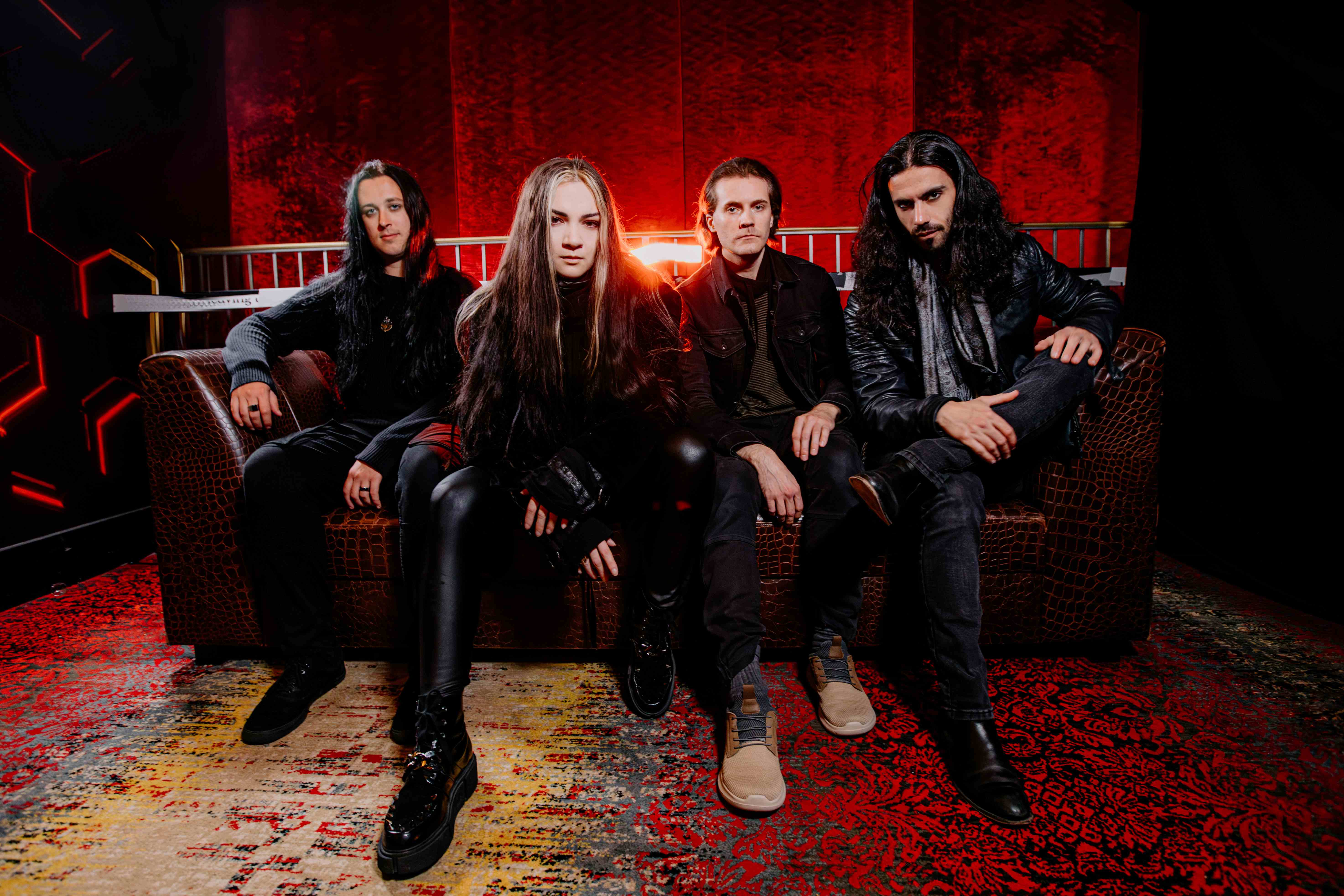
To say SEVEN SPIRES are slowly making their mark on the world is an understatement; their diverse sounds have seen their fanbase and listener count grow each day. They are due to start their European tour soon, and one of those dates is Power Metal Quest Fest, taking place in a matter of days. Before they embarked upon their tour, Rock Out Stand Out’s Lotty Whittingham spoke to the band about their upcoming tour, their sound, and mental health. Here’s what happened.
Hello there, it’s great to speak to you. You’re due to play at Power Metal Quest Fest as part of your tour with Sonata Arctica, how are you generally feeling about it all?
Peter: It’s a relatively short tour. It’s three shows in the UK with Sonata Arctica and believe it’s their 30th Anniversary or something like that.
Jack: That’s next year.
Peter: Ah OK. So they got a whole world tour going on in order to celebrate this so I believe this is part of that. We’re really excited about it, I remember when we in Seven Spires were all wee babies and we opened for Sonata Arctica at a local show and it’s exciting to be touring with them now.
And part of that tour is Power Metal Quest Fest. Am I right in thinking that will be your first UK Festival appearance?
Jack: Yes, we’ve played in the UK a couple of times before but this is the first UK festival we will be playing.
Which bands are you looking forward to catching at this festival?
Jack: We’ve been nose to the grindstone with travel documents and other things, to the point where I think, ‘Oh wait, we should look at the poster and figure out what we’re doing.’ We just did two festivals over the summer; one in Germany and one in Spain. I spent the whole buildup to that festival planning who I wanted to go see, and I got to see none of them. It was all just work, which was kind of a bummer, and then I assumed this time it would be the same way: make all these grand plans and not do any of it.
At this festival, there is only one stage so hoping you manage to catch some music this time round.
Jack: Hopefully we’ll be able to see everybody if it’s only one stage.
They’ve also extended the change over times this year too. There’s a great mix of internationally known bands and the best ones from UK soil too.
Peter: Yes, it seems like it. I am particularly excited to see Fellowship because I’ve heard about them a lot; they’ve played some festivals we’ve done in the past, and I’ve been in touch with them a little bit. My brain always goes back to that one music video where the bass player is wearing a big hood, and it’s a cool video. It will be great to see them.
Adrienne: They often come up in my patreon’s discord a lot as well. They will be cool to see.
They’re great, fun and whimsical live; so you will have a great time. So talking about touring worldwide, do you notice any significant differences in different music scenes in different parts of the world?
Jack: There are a lot of differences here and there; there are cultural differences, and depending on where you’re playing—in different countries, the type of venue, or who’s playing with you—it’s always different every single time, but it’s always a nice experience.
Peter: There’s always the local metal club that is beloved but definitely has character, so that’s a whole different thing. I was recently thinking about when we were all kids again, and there’s this venue in Boston while we were all at school there. It’s right by the airport, so there are planes flying over it; it’s right by the beach, but it’s a gross beach. We had some shows there where people were out the door, and the energy was amazing.
When I think back to when we played Wacken earlier this year, it was the same type of energy that we might as well have been cramped up all in one room because it was thousands of people stuck in the mud but still moving up and down. It’s actually amazing to see not the differences but the similarities because even when we went to Japan last year, everybody was just as stoked as anywhere else. So there are subtle differences, but I would say overall, the level of excitement and the kind of energy you feel when you’re on the stage from them remains the same, and that’s an amazing thing.
Jack: It’s pretty infectious; I think sometimes when I see crowds like that, they’re all these people who are just having the time of their lives, and if it were any other circumstance, you couldn’t pay me to be in a building that smells like this. That’s so inspiring in a weird way [laughs]
What you have said has made me think of this. I am interested to hear what has been your favourite venue to play at and your least favourite.
Peter: I love the Worcester Palladium that’s in Massachusetts; I believe it’s 1800s construction and it’s a massive theatre. It’s one of the best sounding rooms, it’s got a huge balcony, and the ceiling is falling apart in a charming way. It’s just amazing; it feels good and it sounds good, it’s in Massachusetts, which is my home. That would be a favorite of mine.
Adrienne: I would say the same. When you are a band in the New England scene, at least when we were, it felt like a rite of passage to be able to play this venue where it was mostly big touring bands that came through and played there. I think it’s because you can hit the Western Mass market, you can hit the New York market a little bit, and the Boston East mass market without having to make everyone try to find parking in Boston, which is a nightmare.
So basically, if you were a local band and could get on a cool tour in the local area where you sold tickets, it felt like a huge step. I have nostalgia and pride in the venue tied to those memories. The first time I met Pete was at a show that we played at the Palladium; we were opening for Arch Enemy, and that was the first time we opened for a big touring band. So the Palladium is a home base full of nice memories.
Peter: I have a couple of cool memories of the worst venues. We would self-book these tours, right at the tail end of university, and we would sleep in a passenger van with another band. So it would be like nine people sleeping on the benches, in the back, on the driver’s seat; it was a disaster. While I can’t believe we did that, I am very proud that we did. On one of those tours, we showed up to a venue in, I think it was Tennessee or something like that. We arrived and realized it was a house that had been condemned; there was definitely nobody living there.
Jack: It was in North Carolina.
Peter: Ah yes. It looked like a spooky haunted house and we went in there to play the set. It was a great energy like I was saying before but it was the most structurally unsound venue that we’ve played in. It did have a smell about it, I think it was the only time I played shirtless at a Spires show because of how hot it was; there was no air conditioninig.
Jack: I remember that show specifically as it was the most sick I had been on stage. I had a pounding headache, I was already running a fever and then we were in the building in the summer in North Carolina where the air conditioning was broken. They actually advised fans before the show not to attend if they were sensitive to heat. I think that was the most miserable show I played and glad that’s behind me.
Speaking of live shows, I have never seen Seven Spires before. What can we expect from a Seven Spires live show as well as lots of energy like you said earlier?
Jack: I think an interesting thing about us is that we’re often put on shows with Power Metal bands and we are a band that happens to play some Power Metal songs so there’s going to be lots of other stuff to look forward to. We have heavier stuff, faster stuff, slower stuff and it’s going to be a diverse set list for hopefully a great, diverse crowd.
Adrienne: We have had some interesting live experiences, and I mean that in a positive way. Our music is emotional, and we tell long-winded stories. Our first three albums are a concept trilogy, and I think some people are interested in the music, the level of musicianship, the aesthetic, or the melodies, and then some are really into the emotional aspect. We have been on some tours where the pits have been interesting, and I have seen unfortunate things happen, but more often than not, I have seen friends crying in each other’s arms and singing along to these songs.
We’ve never played in Wolverhampton, so I don’t know what the vibe is going to be like. I don’t know who of our fans will be there that I know or don’t know, and I don’t know if anyone is going to be crying, but very often it’s an emotional experience. If I see someone in the front row who I know is crying, and then I start getting choked up, then I have to look away whilst I’m singing.
You were speaking about how versatile your sound is that nicely leads me onto what I was going to ask next. When you’re sitting down to record a new track, do you already have in mind what that style is going to be or is it a case of jamming it out and seeing what feels right?
Adrienne: I think we’re pretty sure about our collection of ingredients. We’re always learning new stuff and adding to the spice box. I think usually when it comes down to sitting down and writing a new song, it’s a matter of seeing what’s in the ether and channelling that to let the song introduce itself to us; our job is then to give it the scaffolding it needs to bloom.
So it’s very rare for us to sit down and say “oh we’re going to write a symphonic metal death song” and very often, the songs will start as a piano/vocal track or as a guitar idea and there’s no way to know what it will become. I had something that was inspired by an Edward Elgar piece, it was strings only and it became a part of The Old Hurt of Being Left Behind which I would classify as a very melodic melodeath type of thing. There’s no way to know.
Peter: I will also say that while the intention is definitely there from the beginning, like Adrienne said, a lot of the ingredients are there; that enables us to embrace spontaneity and other aspects. When it comes to the tracking itself, that is where there is space for really cool moments to take place. Jack is usually running the sessions when we’re tracking, and we’ll find amazing moments that happen unexpectedly in the execution of some of these parts.
From a bass tracking standpoint, sometimes I’ll lay something down and then think it wasn’t good, but then I will listen back and I will like it; but not for the reasons I thought. So there are things like that I think can make a track really cool. There’s a Spires song where, right before some heavy impact, there’s a string sound of my hand moving on the string, and for some reason, I think that’s really cool. That’s a weird example, but it’s moments like that I really enjoy.
When the music comes together, does that inspire what vocal style you’ll use Adrienne?
Adrienne: Sometimes it does, especially if the song starts with a guitar idea. Usually I let the emotions of the song dictate what I sing, it’s very rarely a conscious choice but if I deliver a vocal talk line, I can easily go back analyse and why I chose it. I would be thinking “this is what it would sound like if I was in emotional agony” or “you can hear the smile and hope in my voice so that’s why I chose a warmer vocal tone”.
Going back to you saying you being inspired by Edward Ulgar, has there been other moments of your lives where you have been inspired? Whether that’s from reading a book and thinking a sentence would be a good lyric or watching a film and loving a certain part of the soundtrack.
Adrienne: Sometimes when I am talking to people, scrolling through Instagram or reading comments; I’ll see a beautiful phrase. One time I heard someone say “take the winds as they come” but I heard the word winds in the literal sense as we write about sailing the ocean in a chase the endless horizon kind of way. I thought that phrase was beautiful so sometimes it’s in very unexpected human mundane moments.
Peter: There are a lot of moments like that happen. From a non lyrical stand point, there are things within us that just come out so when you’re going through the creation and the execution of the performance of these things, we forget what’s influenced that but they still show. That’s how I would categorise one of the aspects of that.
Adrienne: Also re-visiting old media that I really loved like video games or films. When I watch for example Spirited Away or any of the Hayao Miyazaki films I really loved as a kid/early teenager, I get the pure forms of feelings that I had at the time before I was tainted by adulthood basically. Hearing the sounds that I heard when I first really experienced that pure feeling, I’m able to understand why this interval or this musical family of instruments sounds like starting over against my will or feeling alone or standing on top of the French Alps staring into the mist. Sometimes watching kids films or playing Xenoblade that were my favourite video games, it was a lot of solitary time in my early youth. There’s a lot of feelings and a lot of good musical inspiration there.
Hearing those sounds again must also bring some sort of comfort too.
Adrienne: Yes exactly. It brings comfort but it carries the ghost of what you needed the comfort from and that can be a very powerful and emotional form of storytelling. Especially when it’s with popular media, I mention for example Spirited Away and I see that feeling in their hearts when they think of it. It’s great when you can find a way to quote that melody or the ensemble. Hozachi uses a lot of stacked fourths when composing so I started playing with a lot of stacked fourths and started to be able to compose music that captured how I felt when I first watched those movies.
Thank you for sharing that, that leads me nicely onto my next question. At Rock Out Stand Out, we try and promote the message of normalising talking about your mental health. What’s the biggest lesson you have learnt when it comes to looking after your wellbeing?
Jack: I have a good answer for this question that I talk about a lot. One thing that I have noticed a lot over the years, both with myself and with people in general, is that we’re so quick to judge and attribute other people’s actions to a flaw or something about their character. A good example of that is if you’re driving and someone cuts you off, you think, “oh, that person’s an arsehole,” but if you cut somebody off, you think, “oh no, sorry, I was trying to get into this lane.” If you do it, it’s all about “well, I didn’t have a choice, I’m so sorry,” but if they do it, they’re an arsehole. It’s called the fundamental attribution error bias that all of us do without even thinking about it.
I started to think about this and that it’s important to develop an empathetic filter where if you’re hypothesizing why someone’s doing something or why someone feels a certain way or something doesn’t make sense to you, break that loop of thinking and consider what you’re missing, what you might be getting wrong, and if you were in that position, why would you do that. If you approach life in that way, it’s easier to not be angry, anxious, or upset about things that happen to you. At least that works for me; it helps me be less reactive and more understanding. If I had one thing, that would be it.
Dylan: An ongoing thing is, when you are dedicating your life to a creative field, it’s very easy to tie in a lot of your self worth within in the thing that you’re doing. It’s really easy to basically think if I can’t play a certain way or if I can’t write a certain way that’s somehow leads to me thinking I’m not good enough to not only do the thing I want to do but for people in general.
It’s always an ongoing thing to separate the art that you create because you tie so much of yourself to what you put out in the world; it’s really easy to think when people enjoy what you put out into the world, they like you as a person, or if they don’t like it, it’s somehow a personal attack. It’s an ongoing struggle to separate yourself from the work that you do because you’re worth more than the art that you put out, and it’s two different entities of your self-worth as a person versus you as an artist. It’s an ongoing struggle to not put everything within your art when it comes to who you are as a person, but you have to continuously express that you’re not just an artist, that you’re actually a human being who enjoys other things in life, which is part of who I am rather than this thing I have devoted my life to.
So trying to find that balance is a really crucial thing that’s always going to be an ongoing struggle but knowing that makes it easier to understand why I feel a certain way.
What you were saying reminded me of what another artist said. We were talking about not relying on the validation of others to boost ourselves; he pointed out that as a musician, external validation is needed to help them keep going. Would you agree with this or do you have a different perspective?
Dylan: Yes, I mean it’s kind of a back-and-forth thing. Ultimately, you do art for yourself because it’s something you need to express that you can’t express in any other conventional way, and sometimes we seek validation because of the work that we do. Ultimately, I’m doing this for me, as I need to get this out there, and I need to experience what it’s like to make something and put something out in the world. Sometimes it’s difficult to seek validation from people who don’t necessarily have your best interests. Separating your self-worth versus the worth you put in for your art, that’s always going to be an ongoing thing.
Jack: Especially when you make art that’s an honest expression of yourself. When it’s such a deeply rooted part of you and then you’re saying, “hey world, here it is.” So when people don’t like it, there’s such a complex nuance there between, am I this or is it the expression of me that they don’t like? It gets harder and harder, the better you get at making art that’s the accurate expression, to feel that. They’re kind of inching past each other as you go.
Adrienne: I have the opposite experience. I started making more and more honest stuff, not caring about trying to prove myself to anybody. It got easier to not give a fuck; if I know I did something, that’s exactly how I meant to do it, and I have no regrets. Nobody can say, “maybe you should have done it like that.” If I wouldn’t agree, I won’t care. If somebody doesn’t like it, thanks for the algorithm boost, I guess. I’m kind of mad when somebody writes something shitty because I think, “you could have done five push-ups with that energy, and you wanted to tear me down instead.”
Jack: They chose to not get shredded [laughs]
Adrienne: Exactly, that’s on them. That would lead to what’s the most important lesson, which was learning to trust myself because I had a really big problem with not realising I was constantly getting in my own way. I was also constantly so exhausted and afraid, so I would willingly hand over the reins of my life to other people, and that always landed me in a bad situation. Then I would have to spend more energy getting out of that situation.
As soon as I started saying “that’s bullshit” and began believing that I was right about myself this whole time, I started making decisions from that standpoint and started making art from that standpoint. I stopped giving way less fucks about if somebody didn’t like the song or if they thought we weren’t going in the “right direction.” I got my first two tattoos about this theme; one is a dragon that represents not letting others take away your power, the other is two koi fish, with one swimming up and the other swimming down, which values tenacity and also knowing when to cut your losses and move on and being at peace with that.
Peter: I think you’ve all covered some amazing things and this is why we’re a band. We have conversations like this by ourselves as a band, it’s really beautiful to see as everyone brings a different perspective but a really genuine part of their own experiences. For me, thinking about what everyone else said, I think it’s important to remember that everything is not what we think it is so that’s always going to be a factor here and things aren’t the way they seem. It’s also important not to make things about yourself and also everything is going to be OK, that’s an important thing to remember sometimes. That’s usually the order I operate on things as well.
Adrienne: [to Peter] I also learnt that everything will be OK, from you.
Peter: We all help each other.
What do you like to do to relax and unwind?
Adrienne: Things that take me out of the stressed state of mind and put me into the relaxed state of mind, I love going to the hair salon. I’ve been going to the same stylist for the last seven years, I won’t let anybody else touch my hair. I had boxed black dye in my hair and she got it to this very light blonde so nobody else is allowed to touch up my hair. I also like to go for two/three/four hour hikes, I love to go outside and burn my anger off that way. There’s a cat, I think it’s a neighbourhood cat; she has an owner, she looked very homeless when I first found her and so at the end of my days, I will go for a walk to our spot and feed her dinner. That puts me in a good state of mind.
Dylan: Usually being still and relaxing at home where everything just comes to a pause and where you don’t have to think about anything and just relaxing. So sleeping a lot or in the winter time, there’s a spot in Toronto underneath the highway where they have converted it to a huge skating trail that takes you all the way around the city and one thing I usually do in the winter is wait until there’s hardly anybody there, usually around 11pm/midnight and skate the entire trail. That’s always a really cool thing.
Peter: [to Dylan] We got to do that.
Jack: I am so in.
Dylan: It’s so relaxing, it’s one of those great trails where you can see a good chunk of downtown and you get the mixture of downtown and a hiking trail converged in a very Canadian way.
Jack: If I’m travelling, I like to read for some reason. I like reading and I like stories but there’s so many visual distractions when I’m travelling that it’s nice to see something static. When I’m home, I tend to game more. Both are very story oriented things, I don’t game for the action side but more for the emergence of whatever story or media. My other discovery this year is that all those people that talk about exercising as being relaxing were right and that’s very annoying [laughs] I really got into rowing this year, that lead me down a trail of thinking “what else were they right about” and now I am experimenting with not doing certain things two or three hours before going to sleep. I’m trying to be the best relaxer of all of them. [laughs]
Peter: The outdoor componenent is common between all of us along with the physical excersise componennt. I live next to a giant lake and every day after work this summer, I jumped into the lake. Even in my clothes, there were a couple of times where I was really stressed out and I went fully clothed into the lake so that’s been nice. Definitely hiking, I am more along the lines of a multi-day hike so hiking is really nice. Playing the upright acoustic bass is also very relaxing just because of the low acoustic frequencies and stylistically, you can engage in different types of music. Reading is one of those relaxing too. I live in near complete solitude a lot of the time and in general that can be pretty relaxing because at any point, if I just change rooms in my house then all of sudden it’s a different world and a different state so that’s kind of nice too.
Speaking of gaming and reading, who would be in your dream battle team?
Adrienne: Who are we fighting?
At the top of my head, orcs.
Peter: I call Obama.
Adrienne: If we’re slaying orcs, I would like to have Legolas and Gimli. I would also like to have Alucard from Castlevania, the Netflix one. I think they would all have a nice competition to see who can kill the most in the least amount time. I would hold down the fort and maybe make a nice potato meal for them to eat afterwards.
Jack: I think I grew up on too much anime because I can give one character that would have no problem with the entire battle and I would just kick back and drink coffee. It would be Goku from Dragonball and then I’ll be playing Texas Hold’em with five other friends whilst we wait.
Dylan: I would say if you get the one summon from Final Fantasy VII Bahamut then it kills everything and does perfect damage. So I would have him and then I would scroll on my phone doing logistics whilst he just wrecks and destroys everything.
Do you have any messages Seven Spires fans and our readers?
Peter: There’s a lot more to look forward to when I comes to seeing us. We may be where you are in 2026 so keep an eye out. We’re always working on something so if you’re not following us on YouTube, Facebook, Instagram or the other social media platforms then follow us there. Keep an eye for things.
Adrienne: We’re super thankful for all the support that everyone shows us. Everything helps; even telling your mum about this sick new band that you found so thank you for the support. Whether you have just found us or been with us from the beginning, we can’t do it without you.
Jack: Come find us, come say hi. Look forward to seeing you all.
You can catch SEVEN SPIRES this weekend at Power Metal Quest Fest. The last few tickets are on sale so grab one now whilst you still can here.
