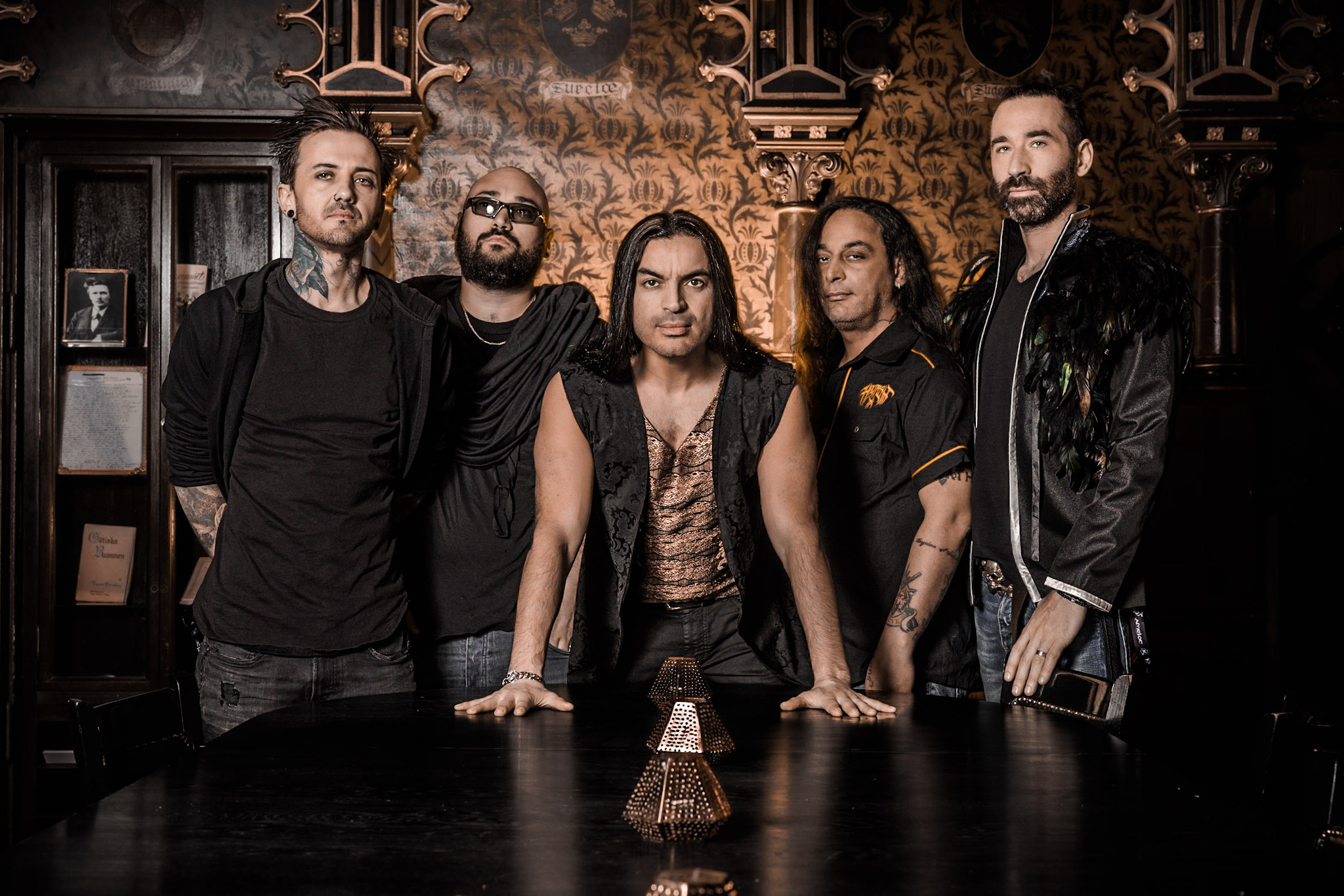
MYRATH are one of the best rising metal bands to come out of Tunisia and the upcoming release of their album Karma is understandably an anticipated one. Ahead of this release, Rock Out Stand Out’s Lotty Whittingham spoke to keyboardist Kévin Codfert where they spoke about the album, in particular the process behind creating it, challenges they face being a metal band in their own country and influences.
Hello Kévin, thanks for joining us. I’ve always been curious what the name Myrath means.
Myrath in Tunisian means heritage or legacy. When I met the guys, the band was called Xtazy. They were a small band from Tunisia, there were only four members in the band at the time. When we decided to work together, I told them we will urgently change the name and find a singer for the band. So we brainstormed the idea and Malek’s father had the idea for Myrath.
You’re due to release Karma this Friday, how would you say it differs from your previous releases?
There is mainly one difference, the composing process changed. During COVID, we were touring Europe and it was the last gig before they shut the borders. It was in Lepzig, a little city in Germany. So as a French guy, I could make it back home in twenty four hours but the others, the Tunisian Government didn’t grant them a flight. So here we are stuck in the middle of nowhere and wondering what to do, so I suggested they come to my place and we will see. It took them six months to get them a flight back home.
So we spend six months together, it was quite difficult as you can imagine five or six guys, my wife and dog in a little home. It was really difficult but we took this opportunity to compose as all the bands should compose. When you ask, what is the composing process of a band; they will say that they gather in a single room and we play together. We never did this with Myrath before because of geographical issues, it’s too expensive to keep booking flights to Tunisia and then come back to France. So we would work digitally, sending messages back and forth with ideas and it took a lot of time.
With this pandemic situation, I had the opportunity the work in real time with musicians in front of me. I was spending every morning on my piano, asking Zaher [Zorgati] to find the idea on the melody and Zaher would ask me to try out new things. We could experiment with ideas ten times more than before as it was a lot faster when you are together with somebody in a single room. So we composed fifty songs, we went through the songs we didn’t like and we kept the songs that are now on the album.
Sounds like a hectic and busy time, was this all in your own studio or was there one nearby?
It was in my own studio, I do all of Myrath’s recording and production here for many years.
Given we have mentioned COVID, was 8th March the intended release date or were you hoping to release it earlier? A lot of bands postponed their album releases due to the pandemic.
We would loved to have released it earlier but there are some strategic and promotional moves that record labels need to do. They told me it was going to be released going to be released in February then March. From a musician’s point of view, this is a little bit frustrating because you composed the songs many months before but I also understand the process and I want to take advantage of this process and be sure everything can go fast and smooth.
Did this time give you the opportunity to amend things that didn’t work before or was it ready to go?
It depended on the song as each process for each song was different. We composed about two or three songs before the pandemic but eighty percent had been done together. Of course when you compose songs, you have no idea if it’s good or bad. So generally what we do when we finish the song, we invite a couple of friends to listen. Now friends don’t lie and they will tell you if it doesn’t sound great so we take three or four days away then come back with fresh ears. We will try to change stuff if it’s possible but others we don’t. Whilst we have a process, it can change. I don’t actualise the process of composing so when trying to analyse and describe what we do is very challenging.
During that process, did that give you a chance to experiment with your sound? I made a note of a couple of the track names, Candles Cry is very southern rock.
For Candles Cry, I came up with this guitar riff idea and I told myself ‘let’s try something totally incompatible with this like a finger snaps’ So we tried putting the finger snaps with this guitar riff plus Tunisian sounds. It took a few days to compose and record the song. I like the song very much. The video for the song has a story but it’s not a continuation of the trilogy with Believer, Dance and that sort of thing but it will be story.
That was one of my first thoughts when I first started listening to the album.
Exactly. With regards to doing something different, it could be a failure. It would have been a failure if we continued the trilogy, for two reasons. The first one being that CGI and 3D is really expensive, I’m pretty sure within ten years it would look cheap because if you are with Universal, a big production and you make something that stays good for years but it’s not the case with Myrath. We used a computer to do the calculation of the 3D with the producer of this video and it’s really expensive for a band like ours so doing that each time could be risky for the band. The second reason being that three videos are enough for a trilogy so we need to change.
The other track I made a note of is The Wheel Of Time. There’s very funky rhythms in that track, Red Hot Chili Peppers came to mind.
Maybe there is but they are not the main influence. The main influences are more Genesis, Pink Floyd and it’s little bit more groovy but absolutely no Red Hot Chili Peppers influences. [laughs]
On this album there is a lot of beautiful guitar solos and keyboard melodies. Do you already have in mind what tracks you want the keyboard melodies on or is it a case of playing and seeing what works?
Basically this is the first album by Myrath where there is piano virtuosity because for the previous one, I tried not to do this sort of thing to make sure the songs don’t need it. Only because a lot of progressive bands have been doing this for a long time and it’s boring. I’m not usually a fan of guitar solos, piano solos or anything like that but as a pianist, a concert pianist, I studied with classical music. I was four years old when I started piano so I’ve been playing a very long time. I had an idea of a piano melody I wanted to show so I tried not to do too much and I wanted to make sure it was at maximum value. Which means if the idea wasn’t good, it would be scrapped. From my point of view, this solo was melodic and it was bringing something so I kept it.
Who are your early influences with regards to piano/keyboard playing?
The first one I would say was Rachmaninov. I played a lot of music from Bartók, Mozart and Beethoven when I was younger but each time I ask myself which one I prefer the most, it’s Rachmaninov. This is because it’s contemporary music, it’s still fresh and this guy was a real genius. There is a Russian piano player who is out of this world, his name is Arcadi Volodos and he plays a lot of Rachmaninov. This guy is good, I listen to him a lot. I listen to a lot of classical music and also French music from the eighties.
Going back to Karma, what was the most challenging track to put together?
The most challenging one was Into The Light, first because of the first three months I spent trying to play the piano part as it was a really difficult part for me. Synchronising the arrangements with the violinist and all the backing vocals was also difficult. Finally you end the process with eight tracks, you need to edit all of those. This song was really challenging.
Talking of Into The Light as well, the lyrics being about finding that light at the end of the tunnel when things are rough. It ties in nicely with our website mission which is to promote mental health awareness and normalise talking about it. I wanted to ask, do you notice key differences in mental awareness between France and Tunisia?
We can’t compare the services when there is no service. In Tunisia, the guys aren’t allow to own a credit card, they can’t have cash or euros so when we are touring and they can’t buy something to eat or drink on a flight, that can be really challenging. Of course, in Tunisia there is no platform for music, there is no music business. It’s always difficult when they take a flight as it’s impossible to check if they are real musicians, there was one time where Zaher needed to sing to prove he was a singer so it takes hours when we take a flight. I can’t compare the services between France and Tunisia.
There is a lot of Arabic music in Tunisia, there is a little metal scene and there is a small number of people listening to metal but it’s not growing because there is no market and also when you listen to metal music there, you are not welcome. You’re considered a satanist there when you listen to metal. There is no business there.
That sounds so tough, particularly for those who listen to metal and live there. For a lot of us metal music is an outlet for us, to help let out some anger and stress but to feel wary even when you do it, must be so difficult.
It’s the main reason the band exists, we want to tell stories and try to get better. Most of the musicians, Zaher particularly, have face the depression for years because of the situation of Tunisia and many things We are living through things that other bands can’t imagine, I see a lot of bands complaining but when I tell them Anis [Jouini] needed to sell all of his bass guitars to buy medicine, they stop complaining. We feel anger when I try to describe this, when I say we, I mean me too. As a French guy before meeting the rest of Myrath, whilst I knew it existed, I didn’t experience discrimination. With the band, for example at the airport; the moment we show our passports, everything changes. I am feeling this discrimination with the band and I can understand.
That can really take a toll on your mental wellbeing. Is there anything else you would like us to be more aware of or help in any way?
No, I will continue to talk about music as it took me thirty years to be good musician. I don’t want to talk about politics because you need to be an expert and I’m not. Our little contribution to this world is to help people feel less depressed and it has been proven as I talk with hundreds of fans who told me that we helped them to carry on and get rid of depression. I’m proud of it and it’s enough.
Is there is a message you have for Myrath fans and our readers?
Yes, first of all I am waiting for all the feedback but I am really excited to how the fans are feeling about the album after a few listens. I need this feedback on the music and how we are on stage because we are not doing the music for ourselves, it’s half introspection and half of it is to see people smiling and singing the songs. So I need feedback, so I invite anyone to talk about the album with me just to give some feedback on what they felt about one song or another. Of course, I would like to say we are doing a few festivals this summer so I would love to meet some of you. I’m sure it’s going to be great.
Thank you for speaking with Rock Out Stand Out today and best of luck with the album release.
